About 36 minutes
The Madcap Metalloids — Edition Insights
Other Worlds
8,191 recorded words. 0 minutes difference from this book's estimate.
View Gutenberg source #63843
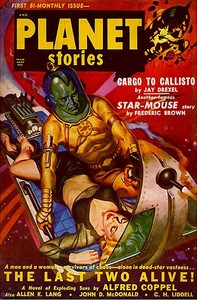
For Cargo to Callisto — Inside the Classic, the stored edition analysis reports 8,263 words, 36 min estimated reading time, and 1 detected text section.
The text analysis averages about 15.3 words per sentence, while the detected sections provide another way to judge how the source is divided.
Project Gutenberg metadata also associates the work with “Science fiction,” connecting these edition facts with the source record’s subject description.
Explore this collection
These alternatives are selected using recorded categories and estimated reading time.
About 36 minutes
Other Worlds
8,191 recorded words. 0 minutes difference from this book's estimate.
View Gutenberg source #63843About 36 minutes
Other Worlds
8,203 recorded words. 0 minutes difference from this book's estimate.
View Gutenberg source #63936About 37 minutes
Other Worlds
8,477 recorded words. 1 minutes difference from this book's estimate.
View Gutenberg source #63890Search stored excerpts and compare books → Choose by your preferences →
Choices use stored catalog measurements. Estimates vary with reading speed. A shared category is a catalog label, not a claim that two books have the same argument or literary quality.
Search reads excerpt text stored with this catalog and links to its associated Gutenberg record. The connection is stored in the site database; this tool does not recheck that every excerpt is word-for-word identical to that external record. Excerpt search does not cover every chapter and does not verify historical publication dates.
Catalog snapshot checked: 2026-09-25. Coverage: 91 public books, 91 available source excerpts.
Read the complete public-domain text at its original source.
Read on Project GutenbergThe story opens not with the escape but with a canal-side picnic: Sarah emerges from the water “as sleek and brown as a seal,” and the easy banter between Joe, Kent, and Ray establishes a domestic normalcy that will soon fracture. Bixby uses this leisurely scene to introduce the Martian setting—sand-coast language, canal weeds, night-crawling nolls—and to seed the central conflict through a telaudio bulletin. The shift from splashing and frankfurters to a hushed group around the radio is the story’s first structural pivot, moving from relaxed character interaction to the intrusion of offstage violence.
The opening’s playful tone—Joe ducking Sarah, Kent’s dry humor about Ray’s appetite—gives way to a procedural mode once the escape is announced. Bixby tracks Joe’s response through concrete actions: he folds a paper over the “cruel three-eyed faces” of the Aarnians, fumbles at the visiphone, and retrieves an atom pistol from his desk. The author lingers on the mundane details of Joe’s job—altering manifests, calling a canal-cab—to ground the escalating threat in bureaucratic reality. The contrast between the picnic’s physicality (water, fire, food) and the office’s sterile screens and papers reinforces the story’s movement between two registers: the sensory world of Mars and the abstract systems of law enforcement.
Water appears throughout as both setting and symbol. The Great Canal frames the picnic; later, Joe travels by canal-cab, and the Aarnians’ escape route involves space and canal ports. Bixby repeatedly describes movement across or through water—Sarah swimming, the skimmer’s hatch, the “miniature jungle of thick leaved canal weeds” where bodies are hidden. This imagery ties the story’s geography to its plot: the canals are arteries of Martian life and potential escape. The skimmer itself, a small boat that carries characters between leisure and danger, becomes a threshold object. Joe’s final return home via canal-cab completes a circular journey that began with the same mode of transport.
The four B-type spacesuit crates function as the story’s central puzzle piece. Bixby introduces them through a visiphone call: Reader reports that Kent altered the manifest, and Joe orders him not to load them without his approval. The crates are never seen directly—only referenced in dialogue and Joe’s internal reasoning—yet they drive the plot’s second half. Their concealment (the bodies are found near “four shiny new B-type spacesuits”) and the scrap of paper with Joe’s letterhead provide the evidence that shifts suspicion onto Kent and Ray. The crates link the domestic picnic (where the plan was discussed) to the off-world cargo system, bridging the story’s two settings.
Bixby uses dialogue and interior monologue to create a gap between what Joe says and what he knows. When Sarah asks, “Anything interesting happen today?” Joe lies: “That’s fine.” The narrator notes his deliberate actions—grinding out a cigarette on a clean plate, flinging his tunic over a plant—as signs of strain that Sarah would normally challenge. This domestic tension mirrors the larger deception: the Aarnians’ escape is paralleled by Joe’s own concealment of his investigation from his wife. The story’s voice shifts from the picnic’s easy banter to clipped, purposeful commands (“Get me a canal-cab”) and finally to the grim finality of blasting the bodies into cinders.
Readers attentive to Bixby’s structural choices will notice how the story’s movement between leisure, procedure, and violence is mirrored in its settings: canal, office, home. The recurring image of water—as pleasure, as transport, as hiding place—unifies these scenes. The incomplete excerpts leave the resolution unclear, but the pattern of escalating concealment and revelation suggests a tight, ironic conclusion. Approach the text as a study in how ordinary routines (picnics, paperwork, marital rituals) become the scaffolding for extraordinary threat.
Sitting with this Mars picnic turning into a manhunt, I remembered the panic of a quiet afternoon unraveling in a secondhand novel from my childhood — that same dread creeping in under warm sunlight. Fog of the Forgotten — Context and Discussion gave me that feeling back, an ordinary setting holding something unsettled beneath. I closed both books, and just sat there.
Create a short personal record of your experience with this book.