About 40 minutes
Last Night Out — Context and Discussion
Machines Invention
9,062 recorded words. 6 minutes difference from this book's estimate.
View Gutenberg source #63988
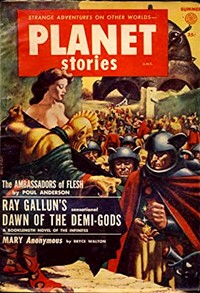
Before opening Mary Anonymous — Context and Discussion, the edition data offers a quick orientation: 10,377 words, 46 min estimated reading time, and 2 detected text sections.
The text analysis averages about 13.8 words per sentence, while the detected sections provide another way to judge how the source is divided.
Project Gutenberg metadata also associates the work with “Science fiction,” connecting these edition facts with the source record’s subject description.
Explore this collection
These alternatives are selected using recorded categories and estimated reading time.
About 40 minutes
Machines Invention
9,062 recorded words. 6 minutes difference from this book's estimate.
View Gutenberg source #63988About 54 minutes
Machines Invention
12,263 recorded words. 8 minutes difference from this book's estimate.
View Gutenberg source #63854About 38 minutes
Machines Invention
8,615 recorded words. 8 minutes difference from this book's estimate.
View Gutenberg source #64722Search stored excerpts and compare books → Choose by your preferences →
Choices use stored catalog measurements. Estimates vary with reading speed. A shared category is a catalog label, not a claim that two books have the same argument or literary quality.
Search reads excerpt text stored with this catalog and links to its associated Gutenberg record. The connection is stored in the site database; this tool does not recheck that every excerpt is word-for-word identical to that external record. Excerpt search does not cover every chapter and does not verify historical publication dates.
Catalog snapshot checked: 2026-09-25. Coverage: 91 public books, 91 available source excerpts.
Read the complete public-domain text at its original source.
Read on Project GutenbergBryce Walton's "Mary Anonymous" (1954) opens with a scene of military tension: three UN officers and a weary professor wait in a tower for a rocket launch. The prose is clipped, focused on physical details—"a slim needle stuck in the ground," a "chemical-stained smock"—and the dialogue is terse, conveying the weight of command. The story quickly pivots from this controlled setting to the chaotic aftermath of sabotage, introducing Mary, the "sweetest, most incongruous little girl" near the launching site. Walton uses this contrast to build suspense, shifting from strategic discussions to Mary's visceral experience of pursuit and crash.
The story's opening establishes a formal, almost bureaucratic tone. Officers speak in clipped phrases: "You may give the firing orders, sir." The professor feels "old, very old," and the relief after the launch is described as a "voiceless sigh." This restraint makes the later shift to Mary's perspective more jarring. Once the rocket crashes, the language becomes urgent and sensory: "a shiver racked the metal," "a scream burst from Mary's lips." Walton moves from abstract strategy—"three tons of G-Agent"—to concrete terror: "the tearing impact was like a thousand echos of her terrors." The change in pace mirrors the loss of control, as military certainty dissolves into Mary's desperate flight.
Mary's internal monologue reveals her isolation. She wonders if the "direction rocket" has stopped probing her mind, and repeats "Free! FREE!" with increasing intensity. Walton uses short, fragmented sentences to convey her panic: "She felt none of the probing demands... Perhaps they had gone away forever." The narrative stays close to her physical sensations—"the hotness of blood burning her ribs," "the wet shine of harsh wood." Unlike the officers, who speak in collective terms ("we've worked long and hard"), Mary's thoughts are solitary. She does not know who she works for or if she will survive. This ambiguity keeps the reader uncertain about her motives, focusing instead on her immediate struggle.
Walton repeatedly uses light as a threatening presence. In the opening, the tower is a "slim needle" and the rocket launch is a distant event. Later, searchlights become "shifting bars of a tightening cage" and "a wire mesh." Mary's crash landing is described as "lights fingered through the leaves," and the beams "flood full and blindingly in her face." This imagery reinforces her entrapment. The forest, initially a "deceptive softness," becomes "harshness of jagged limbs." The story's setting moves from sterile military spaces to a natural world that offers no refuge. These recurring details create a sense of inescapable pressure, mirroring the psychological and physical threats Mary faces.
The narrative accelerates after the crash, with short paragraphs and rapid shifts in sensory detail. Mary "crawled, digging her fingers into the leaves," and the sound of "footsteps, stealthy and invisible" surrounds her. Walton uses ellipses and dashes to mimic her fractured awareness: "She didn't know... whether or not one of the many subsidiary rockets had exploded." The pace slows only when Mary contemplates her freedom, but this respite is brief. The story's structure—from measured dialogue to frantic action—underscores the irreversible nature of her sabotage. The reader is left with the same uncertainty Mary feels: what will happen when she is caught?
Walton's story resists easy categorization. It is part war thriller, part psychological portrait, and its brevity (under 11,000 words) forces a tight focus on Mary's predicament. Readers should pay attention to how the narrative withholds information—Mary's allegiance, the nature of the G-Agent, the fate of the Martians—to maintain tension. The title itself hints at anonymity, a theme that runs through the officers' ignorance of Mary's identity and her own uncertain sense of self. This is a story that rewards attention to its small, telling details: the professor's weariness, the "wet shine of harsh wood," the "slight movement of protective green suiting."
There’s a moment in Mary Anonymous where the sky goes quiet, and I still think about how lonely that felt. Mary’s flight stays with you, long after the last page, like a half-remembered dream. It made me curious about other stories that hold that same ache, which is how I found The Prison of the Stars — A Reader’s Guide. Some books just leave a small, personal echo.
Answer a few questions and save a private reflection on this device.