About 86 minutes
Mirage for Planet X — Edition Insights
Machines Invention
19,565 recorded words. 19 minutes difference from this book's estimate.
View Gutenberg source #63721
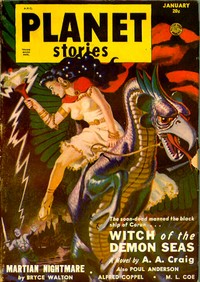
Before opening Witch of the Demon Seas — Story, Setting & Ideas, the edition data offers a quick orientation: 24,058 words, 1 hr 45 min estimated reading time, and 3 detected text sections.
The text analysis averages about 13.6 words per sentence, while the detected sections provide another way to judge how the source is divided.
Project Gutenberg metadata also associates the work with “Science fiction,” connecting these edition facts with the source record’s subject description.
Explore this collection
These alternatives are selected using recorded categories and estimated reading time.
About 86 minutes
Machines Invention
19,565 recorded words. 19 minutes difference from this book's estimate.
View Gutenberg source #63721About 85 minutes
Machines Invention
19,374 recorded words. 20 minutes difference from this book's estimate.
View Gutenberg source #64362About 54 minutes
Machines Invention
12,263 recorded words. 51 minutes difference from this book's estimate.
View Gutenberg source #63854Search stored excerpts and compare books → Choose by your preferences →
Choices use stored catalog measurements. Estimates vary with reading speed. A shared category is a catalog label, not a claim that two books have the same argument or literary quality.
Search reads excerpt text stored with this catalog and links to its associated Gutenberg record. The connection is stored in the site database; this tool does not recheck that every excerpt is word-for-word identical to that external record. Excerpt search does not cover every chapter and does not verify historical publication dates.
Catalog snapshot checked: 2026-09-25. Coverage: 91 public books, 91 available source excerpts.
Read the complete public-domain text at its original source.
Read on Project GutenbergThe story begins not with action but with a political tableau: Khroman the Conqueror, Thalassocrat of Achaera, watches his guards bring in the captured pirate Corun. The setting is established through concrete details—the semicircular bay of Tauros, the marble stairs leading to the palace, the sphinx-lined road—that ground the fantastical elements in a tangible geography. Khroman's refusal to torture Corun, despite his sorcerer's suggestion, immediately signals a moral complexity: the conqueror respects his enemy's bravery.
The opening chapters build a world defined by sea power. Achaera is described as a thalassocracy, its might derived from trade and empire across archipelagoes. The city of Tauros is vividly rendered: a semicircular bay crowded with ships, streets climbing from clay huts to marble villas, and a palace on the highest hill. This physical detail gives weight to the political intrigue. The dialogue between Khroman and Shorzon the Sorcerer reveals a court where sorcery is a tool of state, but not all-powerful—Khroman dismisses public torture as foolish. The captured pirates are led through a mob, and the reader is given a sense of a society where spectacle and power intertwine.
Corun, condemned to death, is offered a reprieve: he must guide a black galleon to the lost Citadel of the Xanthi wizards. The excerpts show him accepting with a laugh, valuing a few more moments of life and love. The voyage is marked by encounters with the Xanthi, reptilian beings who speak in hisses and bleed yellow. A tense parley on the water shows Shorzon bluffing about their powers, while Corun observes the old sorcerer's nerve. The ship is damaged, repairs are made, and the crew presses on toward the black palace. The love triangle with Chryseis is hinted at through whispered endearments after battle, but the excerpts do not reveal its resolution.
The later excerpts bring the party to the Xanthi island, where the castle stands atop a high gray cliff above a little bay. The Xanthi are described in precise, unsettling detail: huge golden forms wrapped in dark robes, wearing tall miters, with fanged mouths and unblinking eyes. Their king, Tsathu, speaks in a bass croak. A silent duel of wizardry between Shorzon and Tsathu shimmers in the twilight, causing panic among sea-beasts. The Xanthi are not mere monsters but a civilization with their own politics—a stooped old Xanthian warns the king to kill the humans immediately, fearing they bring ruin. The excerpts leave the outcome of this confrontation unresolved.
Anderson writes in a brisk, pulpy style that favors action and dialogue over introspection. The narrative moves from the court of Achaera to the open sea to the Xanthi island, each setting rendered with a few sharp details. The prose is efficient: a character's appearance is given in a single sentence, as with Khroman's 'brutal contrast' among the courtiers. The dialogue carries the plot, with characters like Shorzon and Corun trading barbs and threats. The excerpts do not include the story's climax, but the structure suggests a journey narrative with escalating encounters. The use of archaic terms like 'thalassocrat' and 'erinyes' adds a veneer of epic fantasy to the space-opera premise.
These excerpts offer a cross-section of Anderson's novella: a political opening, a perilous voyage, and a tense arrival at the alien stronghold. The reader should note how the author balances world-building with pacing, and how the characters' motivations—honor, survival, love—drive the plot forward. The ending is not included, so the resolution of the sorcerous duel and Corun's fate remain to be discovered.
I remember finding Witch of the Demon Seas during a rainy week, and Corun’s grim loyalty—even to a witch who doomed him—stayed with me. It reminded me of finishing another pulpy paperback and just sitting with its endings left unwritten. Mirage for Planet X — Edition Insights held that same ache: stories that stop too soon, yet leave their salt air behind. Some worlds only need one glimpse to feel like a memory.
Capture what you thought, learned, and would like to remember.