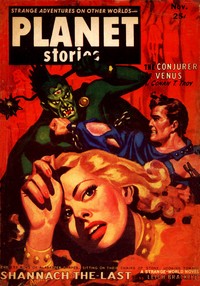
About 32 minutes
Crisis on Titan — Background and Themes
Other Worlds
7,341 recorded words. 2 minutes difference from this book's estimate.
View Gutenberg source #63658

The source record for Mind Worms — Text and Context measures this digital text at 7,757 words, 34 min estimated reading time, and 1 detected text section.
The text analysis averages about 19.1 words per sentence, while the detected sections provide another way to judge how the source is divided.
Project Gutenberg metadata also associates the work with “Science fiction,” connecting these edition facts with the source record’s subject description.
Explore this collection
These alternatives are selected using recorded categories and estimated reading time.
About 32 minutes
Other Worlds
7,341 recorded words. 2 minutes difference from this book's estimate.
View Gutenberg source #63658About 36 minutes
Other Worlds
8,191 recorded words. 2 minutes difference from this book's estimate.
View Gutenberg source #63843About 36 minutes
Other Worlds
8,203 recorded words. 2 minutes difference from this book's estimate.
View Gutenberg source #63936Search stored excerpts and compare books → Choose by your preferences →
Choices use stored catalog measurements. Estimates vary with reading speed. A shared category is a catalog label, not a claim that two books have the same argument or literary quality.
Search reads excerpt text stored with this catalog and links to its associated Gutenberg record. The connection is stored in the site database; this tool does not recheck that every excerpt is word-for-word identical to that external record. Excerpt search does not cover every chapter and does not verify historical publication dates.
Catalog snapshot checked: 2026-09-25. Coverage: 91 public books, 91 available source excerpts.
Read the complete public-domain text at its original source.
Read on Project GutenbergThe story opens with Ambassador Phil receiving a final broadcast from Earth, where a billion people cheer his mission to Venus. But the mood is undercut by the ship operator's nervous voice and the Ambassador's own trembling hand. The narrative immediately establishes a tension between public spectacle and private dread, a pattern that recurs throughout the excerpts.
The text introduces a governing body where men are known only by their titles—Executive Secretary, Coordinator for Education—yet privately call each other George, Ahmed, and Sven. This detail reveals a deliberate performance of dignity, a mask that the Ambassador himself wears when he lets his silvery cloak fall. The story repeatedly emphasizes the gap between official roles and human frailty. The Ambassador, at seventy-five, is described as “tall, a little stooped, heavy-shouldered, greying,” a physical portrait that suggests weariness rather than heroic vigor. His smile is “fixed,” his face “lined and tired.” The President’s reassurances—“Take it easy, Phil”—ring hollow against the Ambassador’s internal thought: “It isn’t that.” The text thus builds a portrait of a man isolated by his position, carrying a fear that no amount of official confidence can dispel.
Old Hoag’s story about the vermiforms—space worms that danced in atom-blast and then died—serves as the story’s emotional and thematic core. The worms are initially presented as terrifying, their “natural radiations” misinterpreted as a message. But Hoag reframes them as “morons, incompetents,” creatures whose power was illusory. The key revelation is that the Earthmen’s inferiority complex prevented them from seeing the worms as “no better than children.” This inversion—from cosmic horror to pathetic vulnerability—mirrors the Ambassador’s own psychological state. The text uses the worms to explore how fear can distort perception, turning the unknown into a threat that exists primarily in the mind. Hoag’s urgent telling, at the worst possible moment, underscores the story’s interest in how stories themselves can wound or fortify.
Throughout the excerpts, authority figures attempt to manage the Ambassador’s fear with smiles and platitudes. In Center Room, “all the perfectly sane, shielded men attempted to convey by smiles their confidence.” But the Ambassador “strove with all his considerable mental power to hold the impression of those reassuring smiles,” a phrase that suggests the effort required to believe in them. The text contrasts the controlled environment of Earth’s government with the Ambassador’s visceral experience of being “lapped in weirdness.” The dressers who physically prepare him for the Venusian surface are described as “expert,” yet their actions—jamming his mouth closed, throwing him into the suit—are almost violent. The story thus questions whether institutional support can truly counteract the isolation of facing the unknown alone.
The excerpts leave the Ambassador on the verge of stepping onto Venus, haunted by Hoag’s tale. Readers should attend to how the story balances the external mission with the internal battle against fear. The vermiforms, once terrifying, become a lesson in the dangers of assuming superiority—or inferiority. The text rewards attention to its small, telling details: a nervous operator, a fixed smile, a hand clawing a face.
The rain drummed on the windowsill as I finished Mind Worms, the ambassador’s dread dissolving into something quieter—the universe’s casual shrug. Later, thumbing a shelf, I pulled down a battered copy of Earth Is Missing! — Inside the Classic. Its playful title felt like a strange echo of that same unfathomable ordinariness, as if even our vanishing might be just another footnote in someone’s filing cabinet. I sat with both, letting the drizzle keep time.
Create a short personal record of your experience with this book.