About 40 minutes
The Flight of the Eagle — A Reader’s Guide
Space Future
9,101 recorded words. 0 minutes difference from this book's estimate.
View Gutenberg source #64238
This digital edition of Poison Planet — Reading Notes is described by source-level measurements including 9,036 words, 40 min estimated reading time, and 1 detected text section.
The text analysis averages about 13.5 words per sentence, while the detected sections provide another way to judge how the source is divided.
Project Gutenberg metadata also associates the work with “Science fiction,” connecting these edition facts with the source record’s subject description.
Explore this collection
These alternatives are selected using recorded categories and estimated reading time.
About 40 minutes
Space Future
9,101 recorded words. 0 minutes difference from this book's estimate.
View Gutenberg source #64238About 40 minutes
Space Future
9,155 recorded words. 0 minutes difference from this book's estimate.
View Gutenberg source #64528About 39 minutes
Space Future
8,817 recorded words. 1 minutes difference from this book's estimate.
View Gutenberg source #64175Search stored excerpts and compare books → Choose by your preferences →
Choices use stored catalog measurements. Estimates vary with reading speed. A shared category is a catalog label, not a claim that two books have the same argument or literary quality.
Search reads excerpt text stored with this catalog and links to its associated Gutenberg record. The connection is stored in the site database; this tool does not recheck that every excerpt is word-for-word identical to that external record. Excerpt search does not cover every chapter and does not verify historical publication dates.
Catalog snapshot checked: 2026-09-25. Coverage: 91 public books, 91 available source excerpts.
Read the complete public-domain text at its original source.
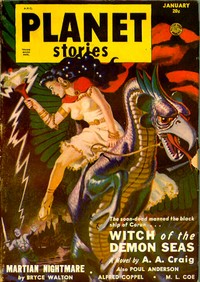
Read on Project GutenbergThe first Earthmen on Venus, as depicted in William Oberfield's Poison Planet, arrive expecting monsters but find only a "misty, drowsing calm." The initial description of Venus as a "land of plenty" quickly gives way to a survival crisis when the crew discovers that the native food is poisonous. The story, originally published in Planet Stories (January 1951), hinges on a single gunshot that plunges the crew into a "Hell from which there was no return."
The catalog subjects list cannibalism and starvation, and the excerpts confirm that the narrative explores these themes through the crew's gradual descent. However, the excerpts also reveal a strong emphasis on scientific problem-solving, culminating in a character named Flaunders who develops a treatment for the poison. This editorial note examines how the catalog subjects align with the actual content, noting both the expected grimness and an unexpected turn toward resolution.
The opening pages establish a Venus that defies pulp expectations. Instead of "wild elephants, giant tigers, pre-historic monsters," the crew finds small, unafraid creatures and birds heard but not seen. The environment is characterized by a "steaming" mist that condenses into life-giving water at night. This setting is described as "mildly tropical Earth without storm and tempest." The only danger initially is the damaged ship, which cannot return to space. The expedition's orders are conditional: set up an outpost or return with information. The crash makes those orders unconditional. This contrast between the peaceful setting and the dire situation sets the stage for the psychological horror that follows.
The excerpts show the crew's deterioration through internal monologue and dialogue. One character reflects on "the torture of starvation to the torture of the shame and bitter self-accusation," describing men becoming "something lower than pigs." The narrative dwells on the purposelessness of survival: "What would that last man do? Go completely mad and try to devour himself?" This is illustrated with a parable of two snakes swallowing each other until nothing remains. The story does not shy away from the moral horror, as characters contemplate suicide and the loss of decency. The catalog subject of cannibalism is thus treated not as a sensational element but as a symptom of a deeper existential crisis.
Despite the grim trajectory, the excerpts reveal a turning point driven by scientific ingenuity. Flaunders announces he has discovered how to treat the fruit and edible animals so they "won't hurt us a bit." He tests the treatment on himself, and the crew celebrates with a "gala event, a banquet, a roaring party." This resolution is abrupt: the story shifts from a suicide attempt to a triumphant feast. The catalog subjects do not hint at this hopeful outcome, focusing instead on the darker themes. The excerpts suggest that the narrative balances despair with a faith in rational problem-solving, a common trope in mid-century science fiction. The ending, while not fully shown, implies that Venus has been "beaten" through knowledge rather than force.
Readers approaching Poison Planet through its catalog subjects should expect a story that does not linger solely on horror. The excerpts indicate a structure that moves from a deceptive paradise through psychological breakdown to a last-minute scientific fix. The narrative voice is introspective, with characters questioning the purpose of their suffering. The resolution, while perhaps convenient, underscores a period belief in the power of applied science. This story rewards attention to its tonal shifts and the way it uses a single setting—the Venusian jungle—to explore both physical and moral starvation.
Reading back through my notes on Poison Planet, those long Venusian nights where every decision felt like a slow surrender, I found myself thinking of a different kind of hunger. Down Went McGinty — Inside the Classic lingers on similar quiet desolations, but with a lighter touch—more about losing one's footing than one's mind. Strange how two such different worlds can leave the same hollow ache behind.
Build a private reading journal entry for this title.