About 70 minutes
Star Ship — Text and Context
Space Future
15,903 recorded words. 1 minutes difference from this book's estimate.
View Gutenberg source #63950
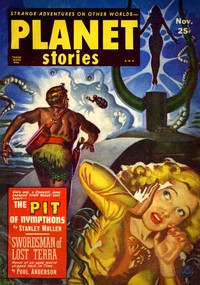
The catalog record for The Pit of Nympthons — Text and Context provides practical reading context through 15,762 words, 1 hr 9 min estimated reading time, and 2 detected text sections.
The text analysis averages about 13.6 words per sentence, while the detected sections provide another way to judge how the source is divided.
Project Gutenberg metadata also associates the work with “Science fiction,” connecting these edition facts with the source record’s subject description.
Explore this collection
These alternatives are selected using recorded categories and estimated reading time.
About 70 minutes
Space Future
15,903 recorded words. 1 minutes difference from this book's estimate.
View Gutenberg source #63950About 67 minutes
Space Future
15,310 recorded words. 2 minutes difference from this book's estimate.
View Gutenberg source #64724About 66 minutes
Space Future
15,102 recorded words. 3 minutes difference from this book's estimate.
View Gutenberg source #64198Search stored excerpts and compare books → Choose by your preferences →
Choices use stored catalog measurements. Estimates vary with reading speed. A shared category is a catalog label, not a claim that two books have the same argument or literary quality.
Search reads excerpt text stored with this catalog and links to its associated Gutenberg record. The connection is stored in the site database; this tool does not recheck that every excerpt is word-for-word identical to that external record. Excerpt search does not cover every chapter and does not verify historical publication dates.
Catalog snapshot checked: 2026-09-25. Coverage: 91 public books, 91 available source excerpts.
Read the complete public-domain text at its original source.
Read on Project GutenbergStanley Mullen opens The Pit of Nympthons with a scene that establishes two contrasting registers of language. Hailard, director of Venusian Exports, speaks in clipped, bureaucratic phrases: “not given to unnecessary elaborations or complexities of speech.” His dialogue is measured, almost ministerial, as he describes the Tihar Forest as “a laboratory of gibbering, unnatural experiments.” Against this, Kial Nasron’s speech is sharp and entitled—she “felt entitled to make a nuisance of herself.” The verbal sparring between them sets up a tension between institutional caution and personal urgency that propels the narrative.
Mullen’s word choices consistently reinforce the alien menace of Venus. The forest is described with a cluster of terms: “vicious,” “nightmarish,” “abnormal,” “lunatic-fringe.” The city ruins are “abandoned,” “dead,” yet the forest is “alive, watching, waiting.” The repetition of “silence” and “muted throbbing” builds a sense of dread. Even the ground delivers “a weak electric shock” that numbs Alston’s arm. The language is visceral, tactile—Mullen wants the reader to feel the planet’s hostility through physical sensation.
Kial Nasron’s dialogue reveals her privilege and determination. She protests Hailard’s advice with “But a convict,” and later uses mock bravado: “At least they did not forget the red carpet.” Her speech is often dismissive, as when she scoffs, “But surely a well-equipped expedition….” Alston, by contrast, speaks in terse warnings: “Watch those things. Some of them are dangerous.” The convict’s clipped, practical lines contrast with Kial’s more elaborate expressions, underscoring their different backgrounds and roles in the story.
Mullen builds atmosphere through layered sensory details. The “rubrous light” and “black shadow like a reaching hand” create a visual palette of red and black. Sound is equally important: the “muted throbbing, like the beat of a heavy, steady pulse” recurs, and the absence of insect hum or rustling wind marks a change. The vine-creeper that “writhed down from the stone frame, darting, coiling, lashing” is described with active verbs that give plant life a predatory quality. These details make the environment a character in itself.
The narrative alternates between dialogue-heavy scenes and descriptive passages. The opening interview between Hailard and Kial is almost entirely dialogue, establishing conflict and exposition. Later, as Alston and Kial approach the city, description dominates, slowing the pace to heighten tension. Mullen uses short paragraphs and sentence fragments for urgency: “The silence.” “Here, too, the pulsing throb was more pronounced.” The shift to Hailard’s perspective in Section IV introduces a new plot thread—the search operation—broadening the scope while maintaining the sense of impending danger.
Readers attentive to Mullen’s authorial choices will notice how he uses language to differentiate characters and environments. The contrast between bureaucratic speech and the visceral descriptions of Venus creates a dynamic tension. The excerpts suggest a story where the planet itself is the primary antagonist, and the human characters must navigate both its physical dangers and their own conflicting motives. Pay attention to how Mullen shifts between registers—the formal, the colloquial, and the poetic—to signal changes in mood and stakes.
Reading the editorial notes on Mullen’s jungle bureaucracy, I thought of my father’s old shipping logs—dull entries, then sudden storms. That same odd comfort returned with Wreck Off Triton — Key Ideas to Explore, where the cold technical language of a salvage report gives way to something rawer beneath, like finding a pressed flower between dense, official pages. Quietly familiar, that shift.
Build a private reading journal entry for this title.